

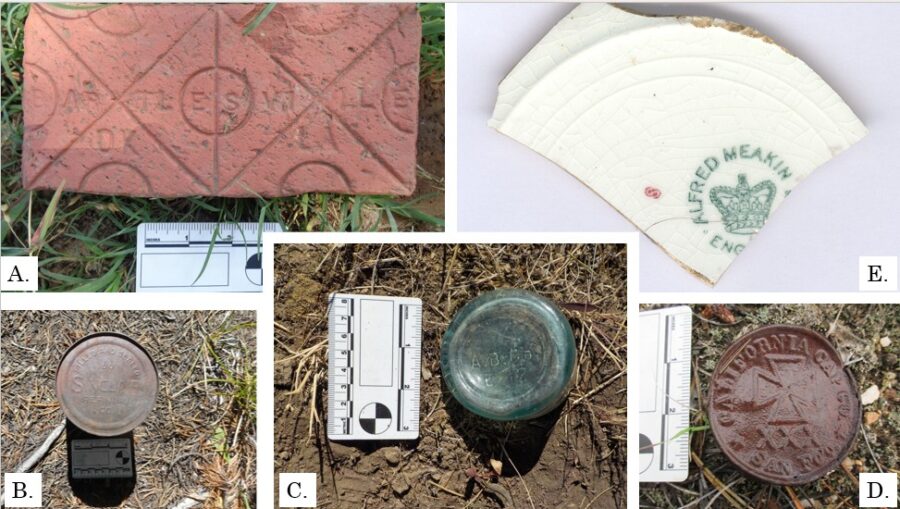
A maker’s mark is as the name suggests, a mark placed on an item (bottles, ceramics, etc.) that represents the manufacturer of the item. These marks can include symbols, letters, numbers, images, or a combination of markers. Maker’s marks generally are diagnostic, or distinctive in characteristic. Most maker’s marks can provide information of not just who made the item, but also when and where it was manufactured. The dating method Terminus post quem (TPQ), which translates to “limit after which,” is defined as the earliest time a cultural layer or feature could occur based on the objects found within it, and the known manufacture date ranges of those items (Kelly and Thomas 2013). An archaeological site’s age is determined by taking the latest manufactured item’s earliest time to exist. Using TPQ, archaeologists can analyze maker’s marks on a site to estimate the age of an archaeological site.
A. Bartlesville brick. Manufactured between 1907 and 1914. “BARTLESVILLE/OKLA”
B. A Sinclair oil can. Dates between the 1940s to 1950s. “FILLED AND SEALED by SINCLAIR REFINING CO.”
C. American Bottle Company aqua glass bottle base. Dates between 1905 and 1917. “A.B. Co., E17”
D. A California Cap Company blasting cap lid. “CALIFORNIA CAP CO. XXX SAN FC’O.” The California Cap Company was incorporated in 1880, and became the primary supplier of blasting caps for the western United States. This style of the blasting cap can was produced between 1890 and 1910 (Martin 1991:20–24).
E. Ceramic sherd. Manufacturer is Alfred Meakin. Dated to 1891-1930. “ALFRED MEAKIN ENG…”
Kelly, Robert L. and David Hurst Thomas
2013 Archaeology. 6th ed. Wasdsorth Cengage Learning, Belmont, California.
Martin, Andy
1991 Blasting Cap Tin Catalog, Over 200 Tins Illustrated. Old Adit Press, Tucson, Arizona.